
Match size to your corner dimensions, material to impact resistance and appearance, and mounting type to your wall surface and security needs. This corner guards buying guide compares these three factors side by side. You can then weigh durability, looks, installation effort, and cost together.
Measure your corner's size and angle first. Pick a guard width that covers the edge fully and a height that fits your space.
Choose a material that matches impact and appearance needs. Polycarbonate resists impacts and stays clear. Metal lasts longest in busy areas.
Select a mounting type that suits your wall. Use tape on smooth walls for quick install. Use screws or nails on rough walls for a strong hold.
Width determines how much of the corner's exposed edge the guard covers. Common widths are 0.75 in, 1.125 in, 1.5 in, 2 in, and 2.5 in. A narrow guard suits a lightly bumped corner and keeps a low profile. A wider guard spreads impact over more surface, which helps in busy hospital corridors and school hallways. Measure the damaged or exposed edge first, then choose a width that covers it fully.
Standard heights are 4 ft and 8 ft. The 4 ft guard is the most common choice for residential and light commercial needs. The 8 ft guard runs floor to ceiling for schools, hospitals, and industrial settings.
The two standard heights for corner guards are 4 ft and 8 ft (or whatever the full height of your ceiling is).
You can cut a standard length down to size instead of ordering a custom length. This approach saves cost and lead time. Specialty sizes such as 1 ft, 5 ft, and 10 ft also exist.
Most outside wall corners form a right angle, and standard 90° guards fit them without special consideration. A 135° corner is shallower, where the wall turns through 45° instead of a right angle. You find these at bay windows, angled reception desks, cut-corner corridors, and splayed returns at hospital and school entrances.
Measure the angle before you order. A 90° guard cannot sit flat on a 135° corner. It contacts only along its edges, rocks under pressure, and the adhesive fails within months because only a fraction of the tape touches the wall. Order a profile made for that angle instead.
A clear corner guard can fit a 135-degree corner only if the profile is manufactured for that angle.
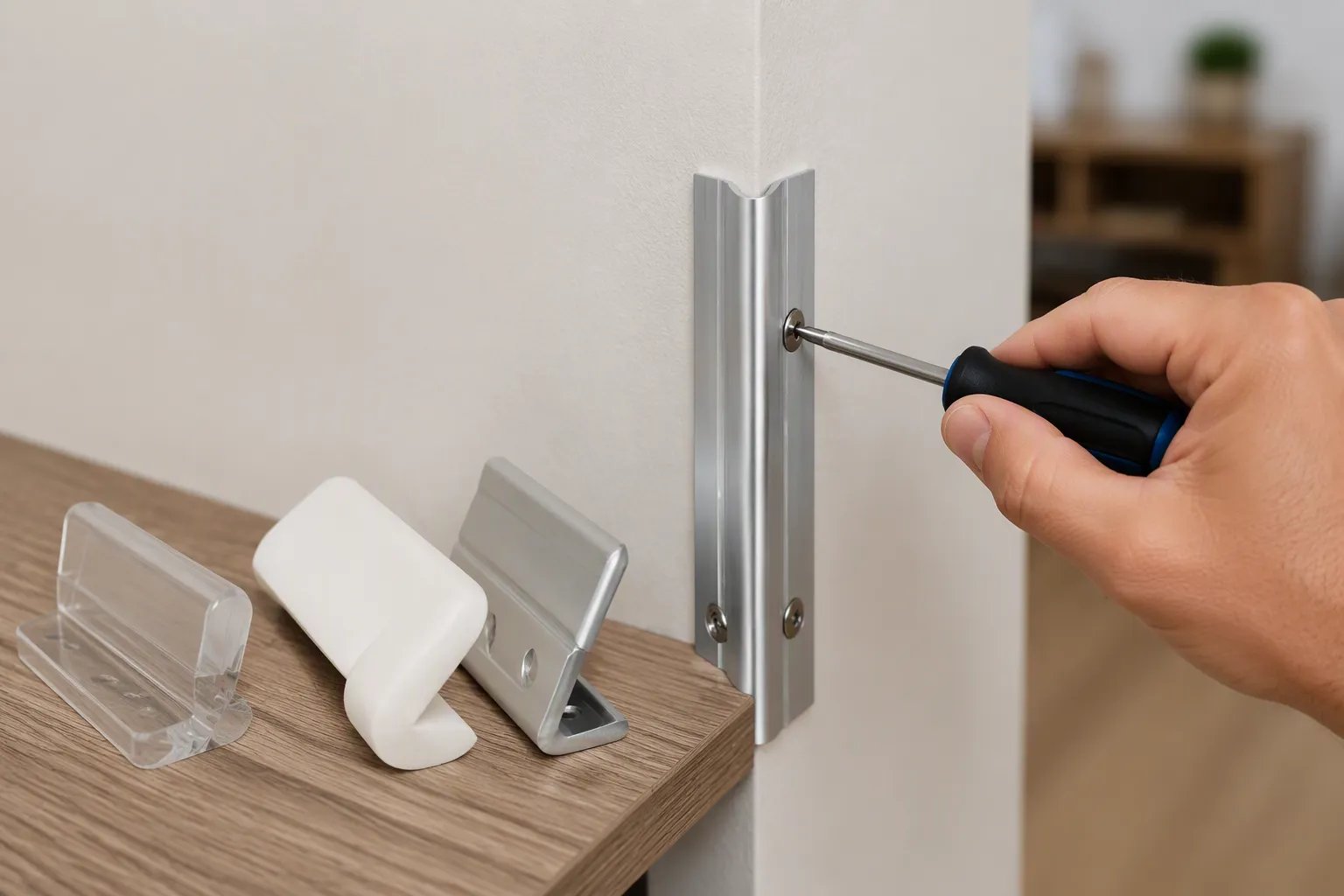
Plastic guards cover most interior wall protection needs, and the three main types differ in impact behavior and cost.
|
Material |
Impact Resistance |
Durability Characteristics |
Trade-offs / Notes |
|---|---|---|---|
|
Polycarbonate |
Highly shatter-resistant; deforms and recovers on impact; outperforms other plastics in strength tests |
Long-term protection in high-traffic areas; transparent so walls stay visible |
Can yellow under prolonged direct UV exposure (e.g., south-facing windows or exterior use); not a concern for interior corridors away from sun |
|
Vinyl (flexible) |
Suited to light-impact areas |
Chosen where cost matters more than clarity |
Lower impact tolerance than polycarbonate |
|
Vinyl (rigid over aluminum channel) |
Added stability from aluminum core |
Reinforced interior wall/corner protection |
Rigid construction, not flexible |
|
Non-PVC plastic (acrylic) |
Brittle; cracks under hard impact |
Cheaper than polycarbonate |
Once cracked, the guard is worse than none—cracked edges are sharper than the drywall corner it protected |
Flexible vinyl guards use a double-sided rubber-based foam adhesive with a thickness of 1/32″. An embossed texture and soft-finish color help the guard blend into interior design. For hospital corridors, polycarbonate is a strong fit: it stays clear, so staff can see wall condition, and it absorbs repeated cart impacts.
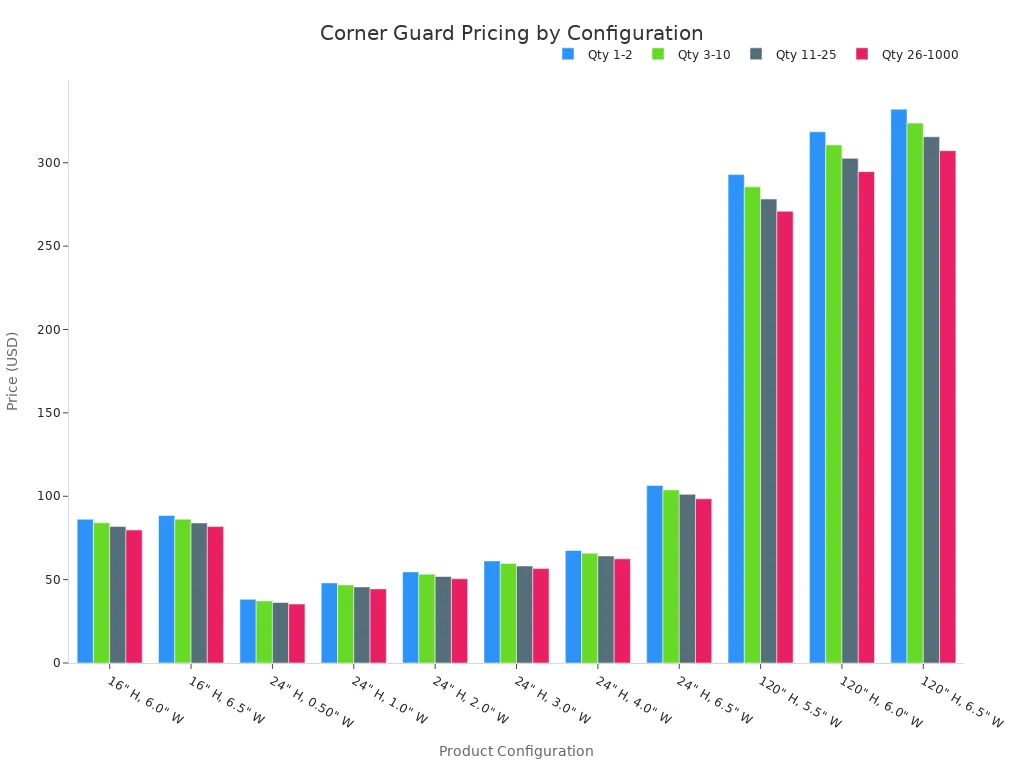
Metal guards suit the toughest duty. Stainless steel, including 304 stainless, resists impact and cleaning in busy hospital and school corridors. A brushed stainless steel (#4) finish is a standard color option. Aluminum offers a lighter metal profile for reinforced protection. Metal costs more than plastic, and the chart below shows how price moves with height, wing width, and order quantity.
Rubber, foam, and wood fill narrower roles:
Adhesive-backed foam guards fit low-traffic areas such as furniture edges and cabinet corners.
Guards with pre-drilled holes for small finish nails or screws suit high-traffic zones such as stair railings and kitchen island edges, where adhesive foam eventually fails under constant stress.
Foam rubber also stabilizes pallet loads and protects cartons during shipping and storage.
Wall corner protection materials are suited to interior walls in homes, offices, hospitals, and other busy areas, where they guard against impacts, cracks, and scratches, reduce repairs, and improve safety.
You have three ways to fix a guard to the wall: self-stick tape, screws, or nails. Each one trades installation speed against holding strength. The right choice depends on your wall surface and how hard the corner gets hit.
Nail-on guards give you a more permanent fixing, which suits commercial projects. Nails also allow cleaner removal when you repaint or repaper later. Glue may be easier and faster, but it dries out over time and the guard can pop off with a sharp bump.
Predrill pilot holes with a bit slightly smaller than the nails to reduce the chance of splitting.
Use eightpenny finishing nails, spaced roughly one foot apart and alternating sides.
Plan on three nails per guard: center and both ends.
Screws work as part of a combined screw-and-nail fastener. Mechanical mounting resists pull-away and shifting far better than adhesive. The guard stays put and the material absorbs the blow.
Pre-taped double-sided adhesive makes vinyl guard installation easy. You peel the liner and press the guard into place, with no tools needed. The table below shows where tape and mechanical fasteners each perform best.
|
Aspect |
Self-Stick Tape / Adhesive |
Mechanical Fasteners (Screws) |
|---|---|---|
|
Impact and shifting |
Weak under frequent or forceful hits; adhesive can shear off the wall |
Resists pull-away and shifting much better |
|
Hold permanence |
Adequate for low-impact areas on smooth, clean, dry surfaces |
Strong, permanent hold for high-contact areas |
|
Installation |
Simple, no tools |
More time and tools required |
|
Key limitation |
Fails on textured, dusty, or oily walls |
Not surface-dependent |
Wall surface decides the match. Smooth standard drywall bonds well with thin film liner tape and construction-grade adhesive. Textured drywall, masonry, and stucco do not hold tape well, so use holes and fasteners there. Vinyl guards with thicker foam tape can conform to lightly uneven surfaces. For high-traffic hospital corridors, screws and nails suit your higher-security needs.
Clear guards protect a finish without hiding it. They preserve the original wall color and pattern, so wallpaper, paint, wood veneer, and feature finishes stay on show. That is why hotels and upscale offices use them. Transparency carries one visual trade-off: anything behind the guard stays visible, including old scuffs, patches, and discoloration. Repair the corner before you install the guard.
|
Aspect |
Effect of Transparency |
|---|---|
|
Overall aesthetics |
Clear guards blend with decor and preserve the original wall finish |
|
Visibility of wall damage |
Pre-existing scuffs, patches, or discoloration remain visible through the guard |
|
Long-term appearance |
Fine surface scratching can build up over years and read as a slight haze |
|
Attachment visibility |
Screws or adhesive may show through the clear material |
Fixings are the second visual issue. Screws and adhesive can show through a clear guard. Color-matched or low-profile fixings reduce that effect.
On a smooth wall, double-sided adhesive tape avoids the issue entirely and is usually the better choice for a visible corner.
Long-term durability depends on matching the material and design to the operating environment. A guard specified for the actual traffic and cleaning routine keeps protecting the corner over time. A mismatched guard may need replacement sooner.
Wipe guards with a soft cloth and a mild cleaner. Avoid abrasive pads on clear faces, because fine scratching accumulates and dulls the surface. Check adhesive edges periodically and reseat any lifting tape before dirt works underneath.
Material choice sets the price band. Acrylic costs less than polycarbonate and stays equally clear, but it cracks under impact. Polycarbonate carries a higher price for shatter resistance. Metal guards such as stainless steel and aluminum sit at a higher price point again.
Height moves price more than any other size variable, and buyers most often over-specify it. Width and custom sizing also raise cost. Trimming a standard 4 ft or 8 ft length usually costs less than ordering custom, and it avoids the longer lead time. Clear and colored guards price about the same at the same size and profile.
Mounting method adds its own cost and labor. Screws give the most secure, long-lasting attachment and suit textured or uneven surfaces. Nails work as a reliable alternative for standard installations. Double-sided tape installs quickly without tools on smooth walls, and industrial-grade adhesive offers the most flexibility during installation.
Traffic level drives replacement frequency, and that drives long-term cost. In heavy traffic, a retainer system with a replaceable cover turns each impact into a low-cost part swap. In light traffic, the cheapest profile that suits the wall is enough. Hospital buyers can compare sizes, materials, and mounting options from PingerPanel as a manufacturer and purchase directly.
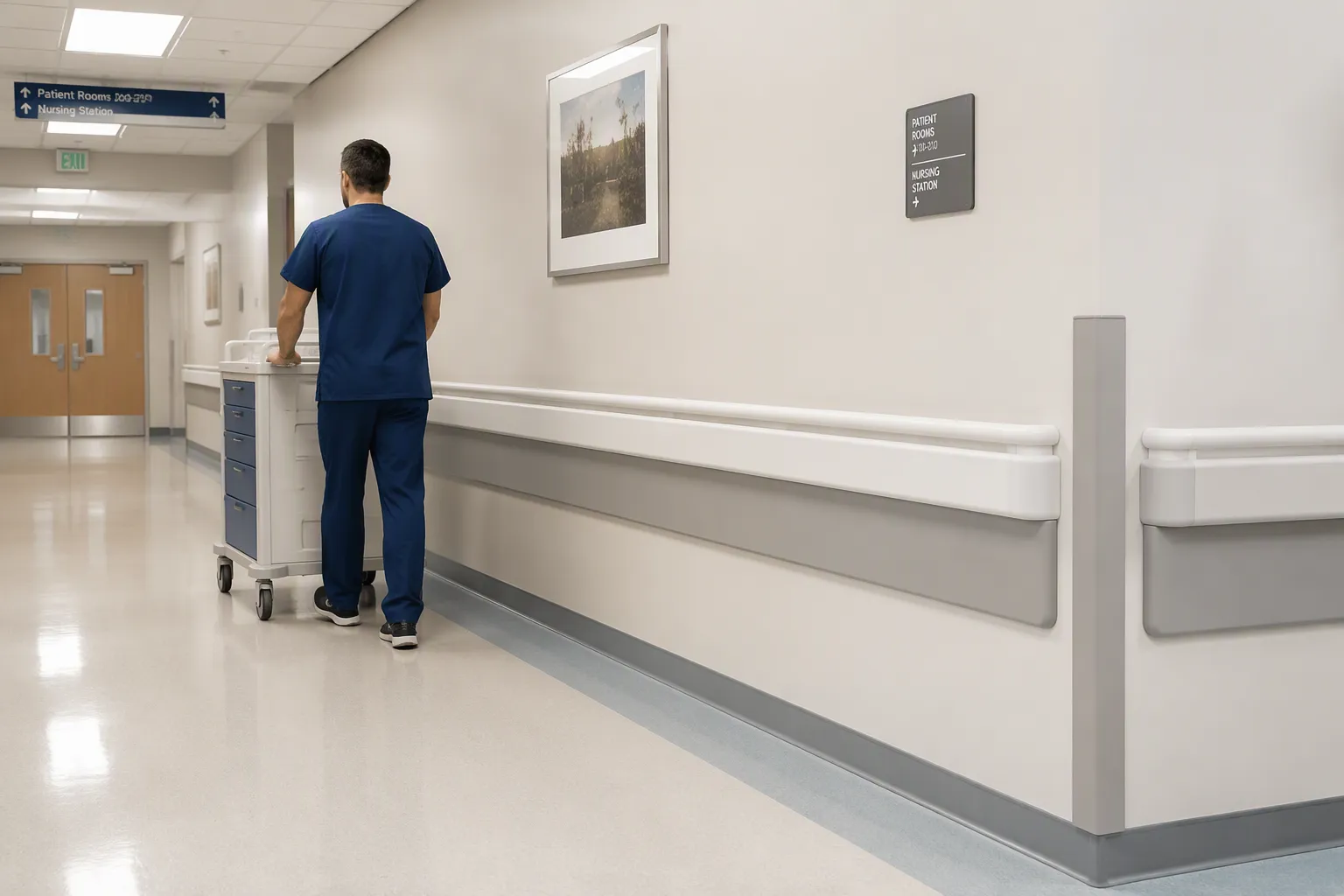
Corner guards protect the vertical edge of a wall. They do not protect the flat wall face along a corridor. When wheeled traffic runs parallel to the wall, a different product covers that surface better. The table below shows where each alternative fits.
|
Alternative option |
What it is |
When it fits better than corner guards |
|---|---|---|
|
Crash rails |
Wall guards for corridors |
Hallways exposed to carts, beds, wheelchairs, and furniture, common in healthcare |
|
Handrails |
Navigation support plus added protection |
Facilities with fall-risk concerns that need ADA-compliant support |
|
Combi rails |
Combined handrail and wall guard |
High-traffic areas needing both pedestrian support and impact protection |
|
Dual rails |
Visible handrail plus wall guard |
Healthcare settings needing a traditional handrail plus wheeled-traffic protection |
|
Rubber wall protectors |
Heavy-duty protectors |
Manufacturing, warehousing, loading bays, and service corridors |
|
Wall strips |
Cost-effective guard alternative |
Waiting rooms, classrooms, and canteens with scuff damage from tables and chairs |
|
Wall cladding |
Protective sheeting for large surfaces |
Broad surface protection; can form rub-rails and kickplates |
|
Bed head protectors |
Healthcare-specific protection |
The wall behind hospital beds; also marks ward areas |
|
Floor-mounted rails |
Rails that divert wheeled traffic |
Counters and glass partitions that cannot be fixed to the wall |
Think about the path a cart or bed takes through your space. A corner guard handles the turn. A crash rail or combi rail handles the straight run beside it. In hospital circulation areas, wards, and corridors, modular PVC-u wall guards resist repeated contact from beds and trolleys. Rubber wall protectors suit loading bays and service corridors, where trucks and forklifts cause heavier damage.
These options work best alongside corner guards, not instead of them. Combine the two for full coverage of a busy corridor. Measure the corner, rank your priorities, then choose the mounting method that suits the wall.
Match size to corner dimensions, material to impact and appearance, and mounting type to wall surface and security. Weigh durability, looks, installation effort, and cost together. This corner guards buying guide closes with one sequence: measure the corner, rank your priorities, then pick the mounting method that suits the wall.
Polycarbonate fits hospital corridors well. It stays clear, so staff can see wall condition, and it absorbs repeated cart impacts. Stainless steel, including 304 stainless, handles the toughest duty and heavy cleaning routines.
Measure the exposed edge first, then pick a width that covers it fully. Common widths run from 0.75 in to 2.5 in. Standard 4 ft and 8 ft lengths can be cut down, which saves cost and lead time.
Yes. PingerPanel manufactures corner guards and sells directly, so hospital buyers, architects, and contractors can compare sizes, materials, and mounting options in one place. This corner guards buying guide helps you match each factor to your project.


 IPv6 mạng được hỗ trợ
 English
 français
 Deutsch
 русский
 italiano
 español
 português
 العربية
 한국의
 Tiếng việt
 Indonesia
 中文